
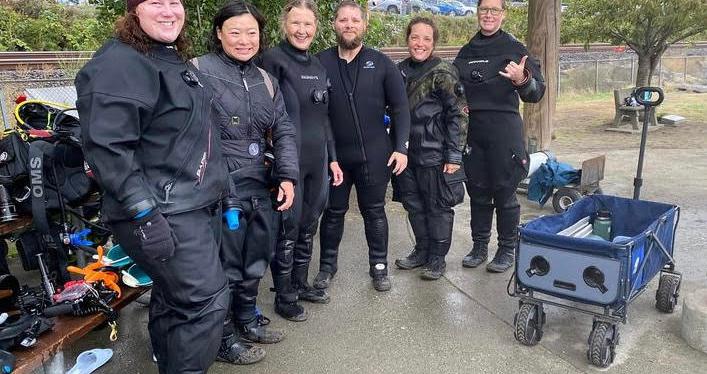
Jade Scuba Adventures (360-233-6825) can assist you with building these skills & pairing the right gear with them!
Intro to Tech is a topic you will see us frequently discussing in the first half of 2025. Tech diving is not just about going deeper for longer. In fact, many Pacific Northwest divers are already using strategies and gear that would be considered “tech-light” in other waters.
In this series, we will delve into how to advance as a “tech-level” diver such as perfecting skills like buoyancy & trim, propulsion, dive planning, improving rescue skills & use of alternative gases. To support their improved skills, serious cold-water divers also need redundancy in their gear, exposure protection appropriate for our conditions & gear to plan your dives.

Why is exposure protection important?
- Local divers know that our Pacific Northwest water temperatures hover in the 50s-60s year-round
- Beyond being comfortable during dives, being warm enough during your dives is also a safety consideration
- In water temperatures 50-60 degrees colder than your core body temperature, it does not take long for the cold to start negatively impacting:
- Your enjoyment of the dive
- Control of your body (like using your hands to adjust your inflation or communicate with a buddy)
- Your judgement (a crucial tool in reducing your risk during a dive!)
- The deeper and longer that your dives are, the more you need to plan for your exposure protection
What do you mean by “exposure protection”?
- Let’s start with your suit for diving
- A 7mm wetsuit is typically the thinnest you will see in our area
- It offers minimal protection for shorter or one-dive-a-day scenarios
- Adding another layer of neoprene around your core (Farmer John style) adds additional protection with additional bulk
- Dry suits for recreational use fall into major categories:
- Neoprene
- Offers “built-in” insulation, but is compressed at depth- affecting buoyancy and warmth
- Trilaminate (preferred by most tech divers)
- Offers great flexibility, mobility in tight spaces or maneuvering in a specific manner
- Lightweight, quick drying, and adaptable to warmer temperatures with lighter undergarments
- In the picture below, Bill (on the left) is wearing a neoprene Pinnacle Tahoe suit and Andy (on the right) is wearing a trilaminate Waterproof D7. You will feel like an astronaut in either suit!
- Neoprene
- A 7mm wetsuit is typically the thinnest you will see in our area
What else do I need besides a dry suit?
- Let’s start with a great hood!
- Much body heat is lost through your head, so a hood with a 5/10 blend (5mm around your face, 10mm on the crown of your head) will offer the best protection against heat loss by ensuring a tight fit around your face and thicker neoprene where you need it.
- Like all neoprene, hoods compress over time and lose their effective heating power (you need to replace it every so often!0
- A high visibility option improves your chances on being seen underwater AND above water
- Our best-selling hood is shown below- a Waterproof 5/10 H2 High Visibility Hood
What about my gloves?
- Being able to use your hands underwater is very helpful!
- Using wet gloves, you will eventually lose dexterity in your fingers as your hands chill
- With practice, dry gloves + liners will offer you excellent dexterity
- See picture below, dry gloves even allow you to carve a pumpkin underwater!
I want to learn more! Text/call Ashley at 360-233-6825 or email info@jadescubaadventures.com





 Jade Scuba Adventures